
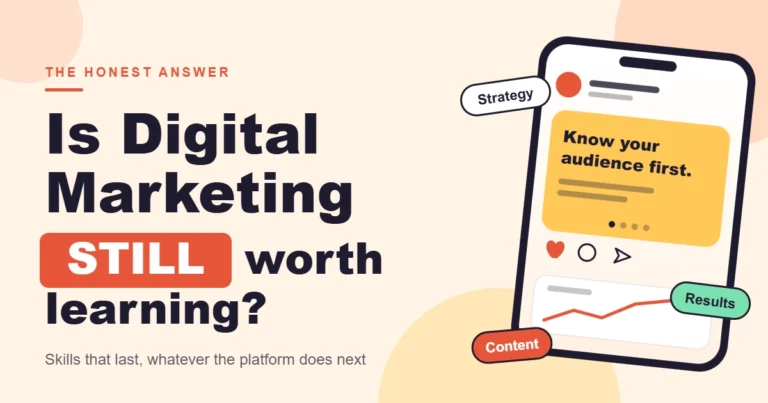
Is Digital Marketing Still Worth Learning in 2026?
Every few months, someone online declares that digital marketing is saturated, dying, or about to become irrelevant. Meanwhile, the small bakery down your street is taking orders through Instagram, your cousin found her last job through LinkedIn, and every brand you admire seems to be everywhere at once.
So which is it? Is digital marketing still a smart skill to build, or are you arriving at a party that’s already over?
Short answer: it’s worth learning, but the way you learn it matters more than it used to.
Why the "It's Too Crowded" Argument Falls Apart
Yes, more people are learning digital marketing than ever. Open any social platform and you’ll find dozens of people promising to teach you how to grow an audience.
But crowded and competent are two different things. Most people who dabble in digital marketing learn the surface: post consistently, use trending audio, add hashtags. Very few understand why one post gets saved and shared while another disappears in an hour.
Businesses notice that gap. A shop owner doesn’t care how many courses you completed. They care whether the phone rings more often after you take over their page. The people who can show that kind of result are not struggling for work.
Every Business Needs Customers, and Customers Are Online
This is the simplest reason the skill isn’t going anywhere. Think about how you make a decision when you need something. You search, scroll, check reviews, look at photos, and ask around in comment sections.
Businesses of every size, from a home baker in Kochi to a regional clothing chain, have to show up in those moments. Someone has to plan what they say, where they say it, and how they measure whether it’s working. That someone is a digital marketer.
The demand isn’t shrinking. It is moving into more places: local businesses, schools, clinics, restaurants, freelancers, and personal brands that never needed marketing help a decade ago.
What Has Changed, and What Hasn't
It would be dishonest to say nothing has changed. Platforms update their rules constantly. A tactic that worked beautifully last year can quietly stop working. Reach drops, formats shift, and audiences get pickier.
Here is what stays steady underneath all that noise:
People still respond to clarity. A confusing offer loses to a clear one, regardless of the platform.
People still buy from those they trust. Consistent, honest communication builds that trust slowly, and no shortcut replaces it.
Good ideas still travel. A relatable story or a genuinely useful tip gets shared, whether it’s a carousel, a reel, or a newsletter.
If you learn these fundamentals, a platform change becomes an adjustment rather than a crisis. If you only learn tricks, every update feels like starting over.
A Practical Example
Take two people who both want to help a local fitness studio grow.
The first posts workout photos daily, adds twenty hashtags, and waits. After three months, the follower count has crept up, but class bookings haven’t moved.
The second starts by asking questions. Who is the ideal member? Busy office workers who want early morning sessions? New mothers looking for something gentle? She then creates a short series answering the exact doubts those people have, such as “What if I’m too out of shape to start?” She adds a clear booking link, tracks which posts lead to enquiries, and drops what doesn’t work.
Same platform, same budget, completely different outcome. The difference wasn’t talent. It was understanding people, a core part of digital marketing that no trend can replace.
The Skills That Actually Hold Their Value
If you’re deciding where to put your effort, these are the areas that keep paying off:
Understanding Audiences
Knowing who you’re speaking to, what they worry about, and what makes them act. This is the foundation of everything else, including content marketing and social media strategy.
Writing and Storytelling
Whether it’s a caption, an email, or a video script, the ability to say something clearly and make people care is rare and valuable.
Reading the Numbers
You don’t need to be a data scientist. But knowing how to read engagement, click-through rates, and conversions tells you what to repeat and what to stop doing.
Basic Search and Email Skills
Search engine optimization and email marketing are quieter than social media, but they bring in steady, lower-cost traffic and are often the backbone of a business’s online presence.
How to Start Without Getting Overwhelmed
Many beginners make the mistake of trying to learn everything at once. A better approach:
- Pick one platform and one goal, such as growing a small Instagram page for a friend’s business.
- Study how real campaigns work, not just theory.
- Run small experiments and keep notes on what happens.
- Build a simple portfolio of results, even from small projects.
Six months of hands-on practice teaches more than a year of passive watching.
Who Should Think Twice
Digital marketing isn’t for everyone. If you want guaranteed overnight results or a job with no learning curve, you’ll likely be frustrated. The field rewards curiosity, patience, and a willingness to be wrong a few times before getting it right.
Final Thoughts
Digital marketing is still worth learning, provided you treat it as a skill rooted in human behavior rather than a collection of platform hacks. Platforms will keep changing. People’s need to find, trust, and choose businesses will not.
Start small, stay curious, and focus on results you can actually show. That combination has always set apart the marketers who last.